
From one model
to many systems
It started with a single CNN. Each project after it answered a harder question than the last — here's the path, milestone by milestone.
Where it began — proving a model could shoulder a life-or-death triage decision.
PneumoAI
A pneumonia CNN that runs entirely in the browser, and shows its own working.
Radiology departments carry backlogs, and a model nobody can inspect is a model nobody can trust.
A 26M-parameter PyTorch CNN quantized to 25 MB and shipped to the browser with TensorFlow.js. Inference, Grad-CAM and a live training demo all run on the visitor's own device, so no server ever receives the image.
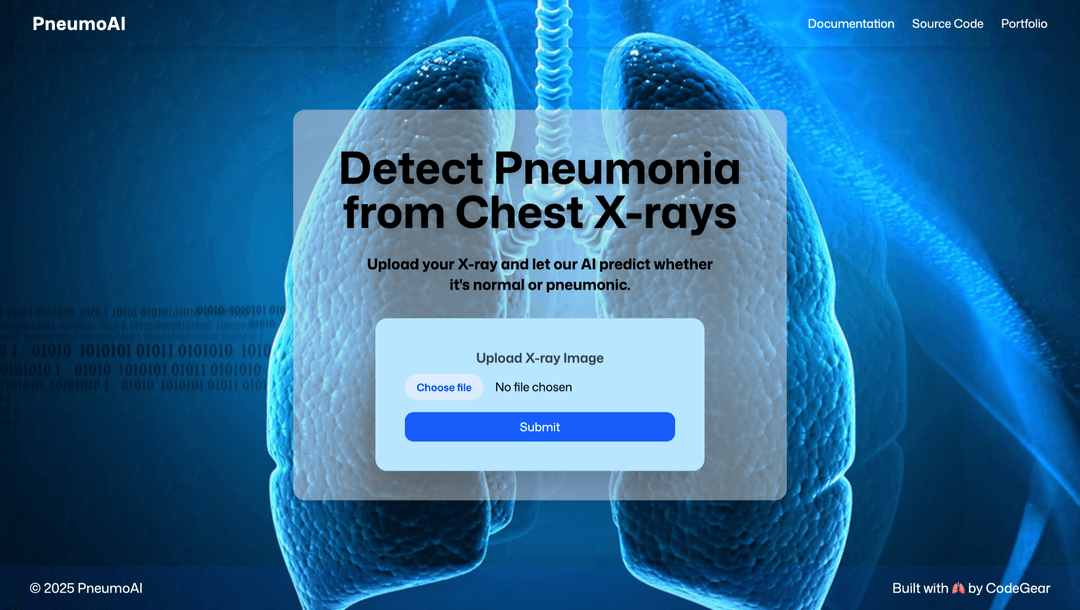
- Zero serversTensorFlow.js runs the model on-device (WebGPU, falling back to WASM then CPU) in about a 15 ms forward pass.
- Real Grad-CAMthe heatmap comes from autodiff gradients, not a proxy, and every feature map shown is the one computed for your image.
- Watch it learna second page trains a small CNN on 512 real chest X-rays live in the tab, scored against a 128-image held-out exam.
- The notebook, renderedthe actual PyTorch training notebook is published in-browser, cells and figures included.
PneumoAI
Where it began — proving a model could shoulder a life-or-death triage decision.
A pneumonia CNN that runs entirely in the browser, and shows its own working.
Radiology departments carry backlogs, and a model nobody can inspect is a model nobody can trust.
A 26M-parameter PyTorch CNN quantized to 25 MB and shipped to the browser with TensorFlow.js. Inference, Grad-CAM and a live training demo all run on the visitor's own device, so no server ever receives the image.
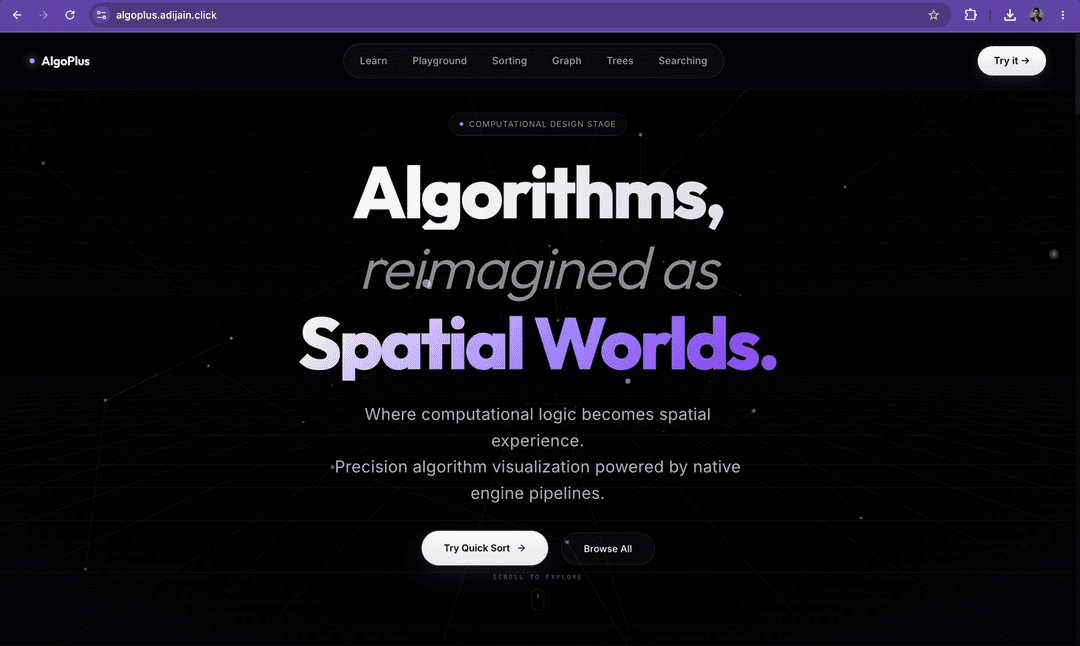
- Client-Side ComputeAll 193 topics simulate in-browser, so there is zero backend load.
- Custom InputLearners type their own data and watch visualizers recompute live.
- AI-Tutor NarrationEvery topic pairs animation with narration and a synced code panel.
The leap into systems — trading JavaScript's ceiling for compiled C++ speed.
AlgoPlus
A full CS degree visualized. 193 interactive topics, all client-side.
The original C++/FastAPI engine buckled under heavy request volume. Every animation needed a server round-trip, adding latency and cost.
Retired the backend entirely: a fully client-side TypeScript platform where every visualization computes in the browser — instant, and infinitely scalable.
AlgoPlus
193A full CS degree visualized. 193 interactive topics, all client-side.
Learning to move at the speed of the market — push, never poll.
CoinPush
Cryptocurrency tracking dashboard powered by live WebSockets.
Market watchers experience lag and heavy network request usage due to standard REST API polling.
A fast cryptocurrency screen terminal fetching live pricing updates via continuous WebSockets.
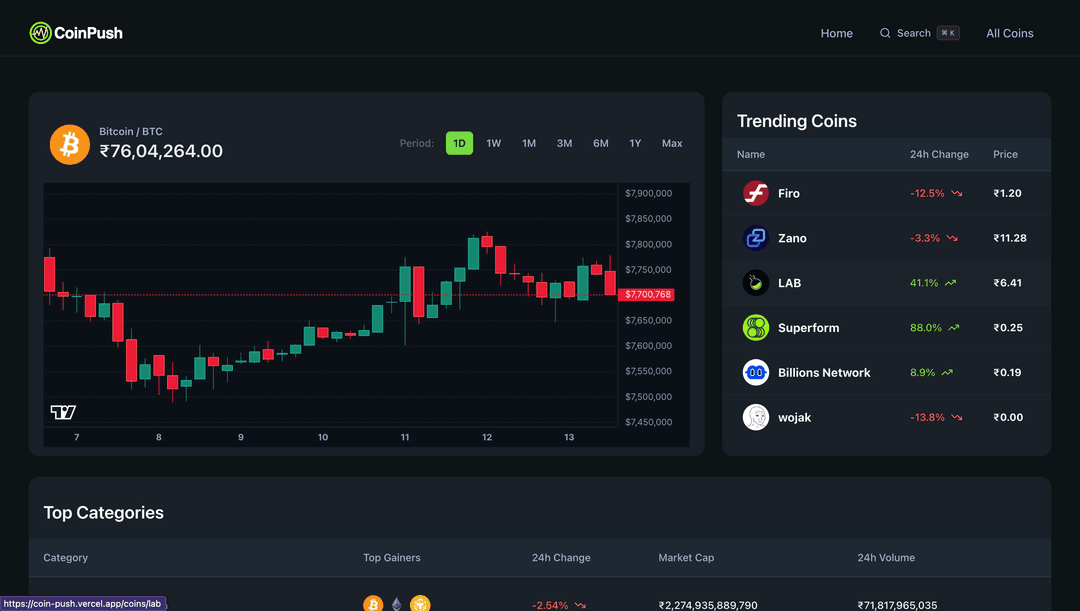
- Auto-ReconnectionKeeps WebSocket state alive during temporary network dropouts.
- SWR Query CachesPrevents duplicate API requests across UI elements.
- Pre-cached LayoutsMinimizes paint latency on initial render.
CoinPush
90%Cryptocurrency tracking dashboard powered by live WebSockets.
- Stochastic Scipy CoreRuns high-iteration wealth distribution paths in Python.
- Offline FallbackComputes mathematical growth curves locally if API connection drops.
- BFF AuthenticationImplements secure backend-for-frontend routes.
Turning uncertainty into something you can see — ten thousand futures, one decision.
WealthyMinds
A financial modeling tool integrating AI guidance with Monte Carlo projections.
Individual investors frequently lack access to complex statistical simulations to visualize risk ranges.
An analytical app linking Gemini 2.0 advisory prompts with a Monte Carlo modeling backend.
WealthyMinds
10kA financial modeling tool integrating AI guidance with Monte Carlo projections.
Building for people under pressure — real-time feedback the moment it matters.
InterviewPilot
Speak to a realtime AI interviewer, solve a live coding round, get graded by five agents.
Candidates rehearse silently, and a mock interview that cannot hear you or interrupt you is not rehearsal.
Built and maintained end to end. Audio runs over a single WebSocket to a hosted Deepgram Voice Agent, so nothing of mine sits between the candidate and the model during a call, and the grading runs afterwards as five separate agents rather than one prompt asked to do everything.
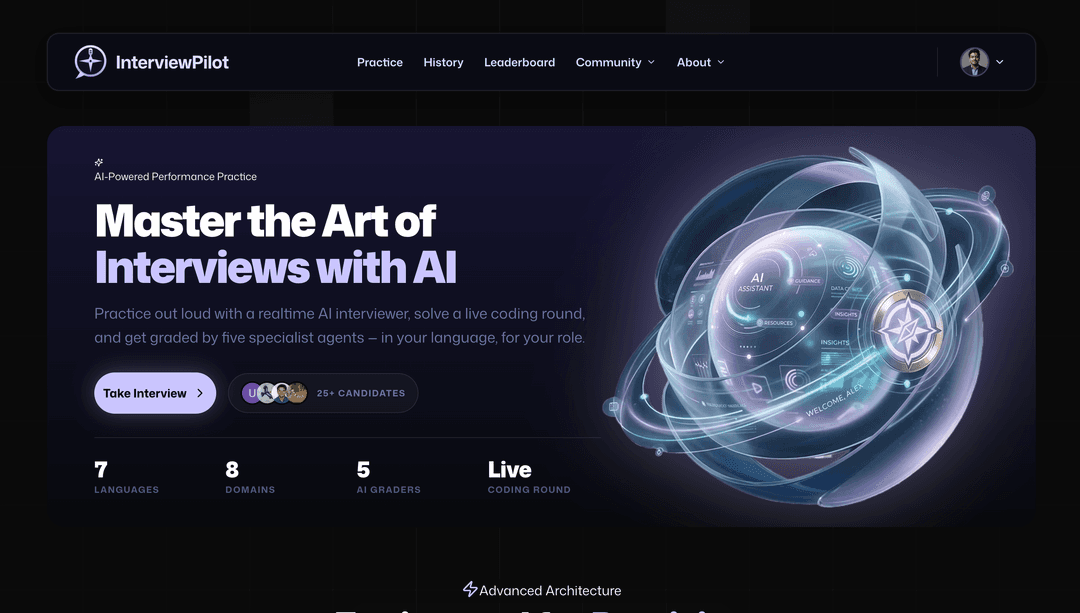
- Barge-ina local VAD detects interruptions, so the interviewer stops mid-sentence without waiting on a model roundtrip.
- Five specialist gradersGemini 2.5 Flash agents with Zod-validated structured output, run only when the candidate opts in at the end.
- 7 languages, 8 domainsAura-2 handles the voices it supports; the rest route to Gemini Live, which trades latency for coverage.
- Live coding rounda CodeMirror panel the candidate works in while the conversation continues.
InterviewPilot
1.2sSpeak to a realtime AI interviewer, solve a live coding round, get graded by five agents.
- Unified AdaptersInterfaces Google AI, Groq, and local Ollama.
- Onion MiddlewarePipeline tracing and validations via Zod structures.
- Local FailoverAutomatically falls back to Ollama if external APIs time out.
Graduating from shipping apps to shipping the infrastructure others build on.
Vectrion
Modular TypeScript library for developer tool abstractions.
Developers write duplicate middleware for prompt routing, logging, and validations.
A typed SDK offering clean adapter routing, prompt verification, and local fallback paths.
Vectrion
< 0.5msModular TypeScript library for developer tool abstractions.
Making the invisible visible — governing architecture before it quietly rots.
ArchLens
Continuous, evidence-based structural governance and dependency graph analysis for software repositories.
Software architecture degrades silently, leading to build-time bloat, circular dependency paths, and architectural debt that linters cannot detect.
A monorepo-based AST parser and dependency graph builder that enforces module rules and calculates explainable structural health scores.
- Dependency CyclesDeterministic cycle detection across multi-package codebases.
- Structural ParsingMulti-stage AST parser resolving module-level import/export graphs.
- Governance RulesEnforces layer restrictions and score thresholds directly in CI/CD quality gates.
ArchLens
0 CycleContinuous, evidence-based structural governance and dependency graph analysis for software repositories.
- Multi-Stage PDF PipelineCombines pdfminer and PyMuPDF fallback for perfect document intelligence.
- Vector RAG LayerStores historical question papers in ChromaDB for high-precision semantic recall.
- Structured LiteLLM RoutingFeatures zero-parse-failure Pydantic outputs backed by Groq APIs.
Teaching documents to answer questions — retrieval over guesswork.
Exyst
Predictive exam analytics engine leveraging LLM-based page classification and ChromaDB semantic RAG pipelines.
Students and educators struggle to extract key focal areas from dense, unstructured historical question papers and university syllabi.
An intelligent processing pipeline parsing PDFs, classifying sections, indexing question embeddings via ChromaDB, and predicting exam papers.
Exyst
91.4%Predictive exam analytics engine leveraging LLM-based page classification and ChromaDB semantic RAG pipelines.
Closing the loop — models that defend revenue, measured in real rupees.
TeleChurn
Interactive FastAPI web dashboard and machine learning pipeline forecasting telecom subscriber churn.
Telecom operator teams lack early, regional-level forecasts of customer MoM subscriber declines to target retention budgets efficiently.
An ML classification pipeline with Optuna hyperparameter searches, SHAP interpretability, and a custom financial ROI simulator.
- Optuna XGBoost CoreMulti-model pipeline benchmarking Logistic Regression, Random Forests, and Boosted Ensembles.
- ROI Alert OptimizerDynamically models ARPU and campaign incentives to target subscribers at peak profitability thresholds.
- Circle Strategy PrescriptionsAutomatically suggests copper retirement, FTTH upgrades, or prepaid value bundles.
TeleChurn
87.2%Interactive FastAPI web dashboard and machine learning pipeline forecasting telecom subscriber churn.